
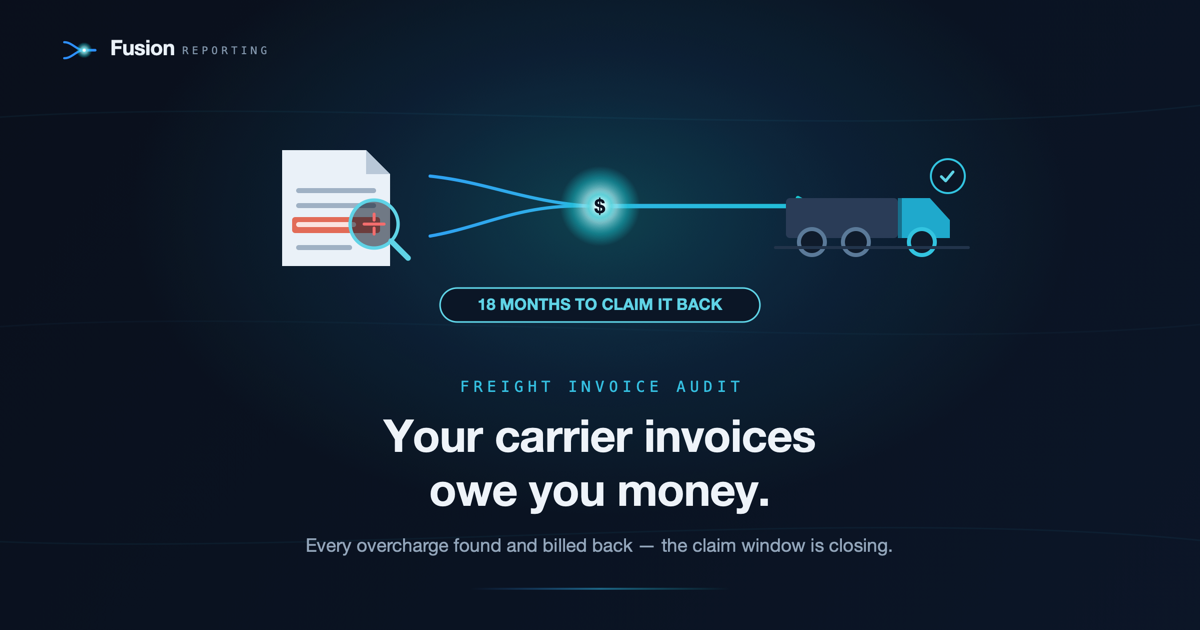
Your carrier invoices owe you money — and the claim window is closing
The issue. If your company pays to ship goods, your carrier invoices contain mistakes — and the mistakes almost never run in your favor. Duplicate bills. Wrong weights and freight classes. Fuel surcharges applied at the wrong rate. Accessorial fees — liftgate, residential delivery, reweighs — tacked on for services that never happened. Contract discounts you negotiated and then never received. Each error is small enough to sail through accounts payable, and together they quietly drain money you already earned.
Why it happens. Freight billing is genuinely complicated. Every invoice is priced off a negotiated rate agreement full of base rates, surcharge tables, discount tiers, and dimensional-weight rules, and nobody in a busy AP department has time to check every line against all of that — so invoices get paid as billed. Two facts tell you how real the problem is. First, the U.S. government audits its own freight bills by statute: federal regulation (41 CFR 102-118) requires post-payment audits of government shipments, because carrier billing errors are a known, recurring fact. If Washington's working assumption is that freight bills contain errors, it should be yours too. Second, an entire industry of contingency-fee freight auditors exists and turns a profit — nobody stays in business working for a share of recoveries on invoices that are clean.
And there's a clock. Federal law (49 U.S.C. § 14705) gives shippers just 18 months from delivery to dispute an overcharge. After that the money is legally gone — not hard to recover, gone. Every month you don't look, the oldest overcharges expire for good.
How it works.
- Send us the paperwork. Your last year of carrier invoices and your rate agreements, in whatever form they exist — PDFs, spreadsheets, TMS exports. No software to install, no system changes, nothing for your team to build.
- We rebuild every bill. We load it all into a database and reprice each shipment against what your contract actually says it should have cost — weight, class, fuel surcharge, accessorials, discounts, line by line. This is data reconciliation, the same discipline we use to verify database migrations: match every record, explain every difference.
- We file the claims. Every overcharge gets documented with the invoice, the contract clause, and the dollar amount side by side. We prepare the dispute paperwork, submit it to the carriers, and chase it to resolution.
- You collect. Recovered money goes to you. We take an agreed share of what actually comes back — and only of what comes back.
What you get. A documented recovery schedule — every overcharge itemized and backed by your own contract — plus the recovered cash, plus a clear picture of which carriers and which fee types are costing you, so the same leaks don't reopen next quarter.
The benefits.
- Zero risk: find nothing, pay nothing. No retainer, no hourly bill.
- Zero disruption: your team sends files once and gets money back.
- Evidence, not opinion: every claim ties an invoice line to a contract line.
- Beats the deadline: an audit now rescues months of claims that will be legally unrecoverable by next year.
If your freight bills get paid as billed — and at most mid-market shippers, they are — there's exactly one way to find out what that's been costing you, and it's free unless we find money. The 18-month clock is already running.
Want it checked? → curt@fusionreporting.com