
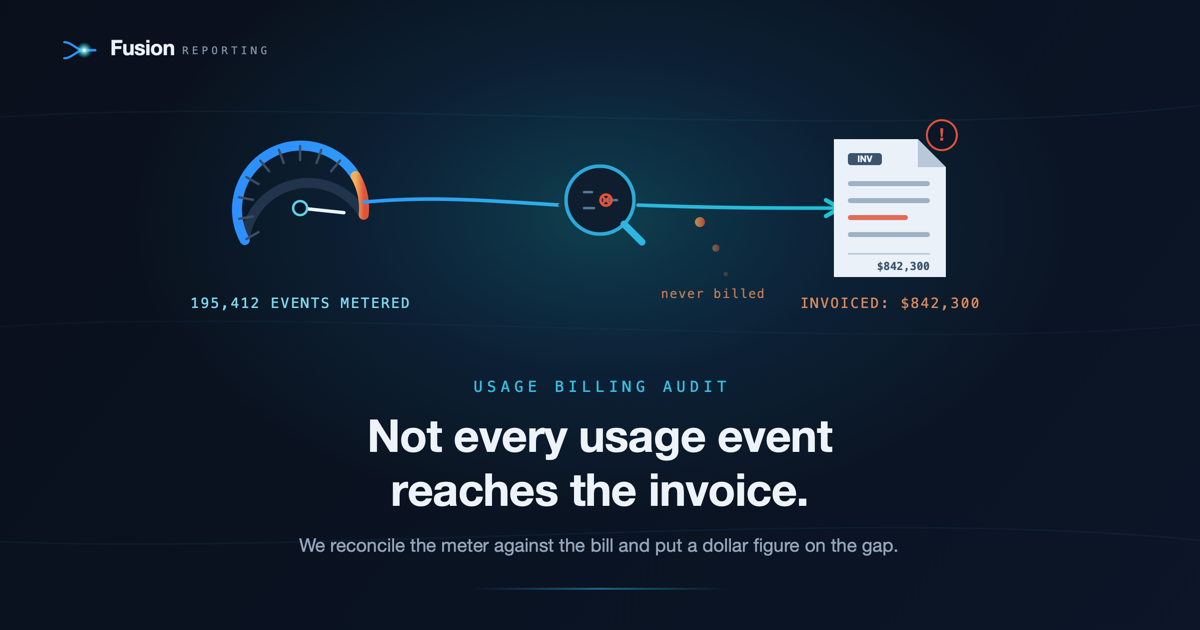
Charging by usage? Some of that revenue never reaches the invoice
The issue. If you bill by usage — API calls, tokens, credits, seats-plus-overage — there's a long path between the event that happened and the line on the invoice. Events get dropped, counted twice, tied to the wrong customer, or priced at a rate that didn't update when the plan changed. The money doesn't vanish loudly; it just never gets billed. Customers complain when you overcharge them. When you undercharge, nobody says a word.
This is measured, not hypothetical. A PwC-run survey of 350 software executives (published March 2026) put revenue leakage at 4–7% of annual recurring revenue — and found roughly two-thirds of executives don't fully trust their own billing numbers, with confidence worse at companies on usage pricing, not better. At $10M in revenue, even 1% — well below the survey's range — is $100,000 a year, quietly gone.
Why now. AI pricing made this worse. Tokens, credit pools, hybrid plans — and pricing that won't sit still: the same survey found half of software companies changed pricing at least twice in a year. Every change is a fresh chance for the meter, the pricing rules, and the invoice to disagree. Even the best-run AI companies get burned — Cursor publicly apologized in July 2025 for a botched usage-pricing rollout and refunded three weeks of unexpected charges. Telecoms learned this decades ago: usage billing at volume reliably leaks, so they've paid for independent billing verification — an entire industry called revenue assurance — ever since. SaaS and AI companies adopted the same billing style without the same safety net.
How it works.
- We pull the raw usage events and the invoices. Read-only access, or you run our extraction scripts and send us the output — we never touch production.
- We replay your usage against your own pricing rules, independently, event by event: what should each customer have been billed?
- We compare that to what you actually invoiced and chase down every gap — dropped events, misattributed usage, stale rates, rounding that always rounds against you.
- We walk your finance and engineering leads through the findings together, so both sides agree on what's real before anyone acts on it.
What you get. One report: the leak, in dollars, itemized by cause and by customer — which invoices were under-billed, which were over-billed, and exactly where in the chain it happened. A number you can take to your board, your auditors, or your next pricing meeting.
The benefits.
- A hard number for what you're leaking — not a feeling.
- Under-billing found is money you can start collecting next cycle.
- Over-billing caught quietly, before it becomes a customer complaint or a public apology.
- It's independent. Your billing platform will never lead with "here's how often our invoices are wrong" — we have no such conflict.
- Fixed scope, plain-English report. No open-ended consulting.
The risk is ours. Our first audits are contingent: if we find nothing material, you pay nothing. If the leak is real, the fee is a fraction of one year's recovery — that's arithmetic, not a sales pitch.
If you charge by usage and can't say for certain the invoices match the meter, that's exactly what we check.
Want it handled? → curt@fusionreporting.com